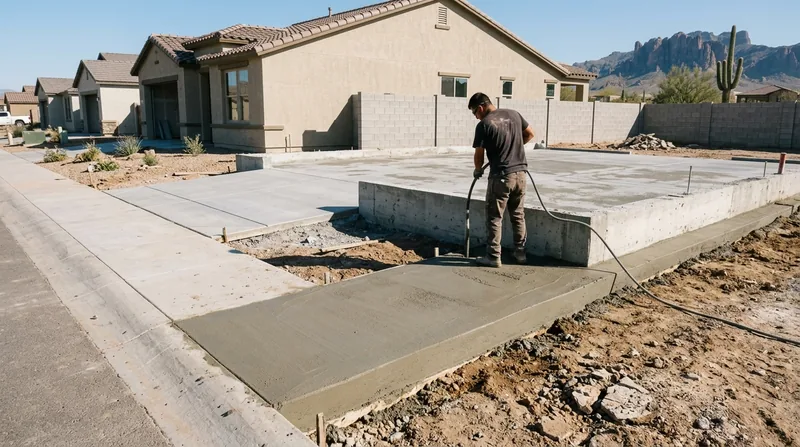




Concrete Slabs & Foundations in Mesa require precision engineering, proper site preparation, and materials that withstand Arizona's expansive clay soils and temperature swings. Mesa's residential lots, from the flat valley floor to sloped hillside properties, demand foundations and slabs built to code with reinforcement and compaction that last decades, not years. Whether you're pouring a garage slab, shed foundation, or room addition footing, the difference between a solid install and a failing one comes down to base prep, steel placement, and finishing technique. Mesa Concrete has poured thousands of slabs since 2016, licensed under AZ ROC CR-9, and we know the local soil conditions, permit requirements, and seasonal timing that keep your foundation stable. Let us handle the engineering, the permits, and the pour so your project sits on rock-solid ground.
Why Concrete Slabs & Foundations Matter in Mesa's Climate and Soil
Mesa sits on expansive clay soils that shift with moisture content, a reality that catches many homeowners off guard when cracks appear in their garage or addition floor. A properly engineered slab with adequate reinforcement, correct thickness, and compacted base resists that movement. Poured foundations for new construction, sheds, and room additions must also account for Arizona's temperature extremes, freeze-thaw cycles (rare but possible at elevation), and the occasional seismic activity that rumbles through the valley. Building to code isn't just about passing inspection, it's about protecting your investment and avoiding costly repairs down the line.
- We compact the subgrade to remove voids and prevent settling.
- We specify reinforcing steel (rebar or wire mesh) sized to your load and soil conditions.
- We pour concrete to engineered thickness, typically 4 to 6 inches for residential slabs.
- We finish the surface for proper drainage and longevity.
- We manage curing in Mesa's hot, dry climate to prevent premature drying and cracking.
Each of these steps is non-negotiable if your slab or foundation is to perform for 25, 30, or 40 years without major repair.
Key info: Mesa's expansive clay soils can lift and crack an undersized or poorly prepared slab. We design every pour with local soil reports and structural requirements in mind, then verify compaction with field testing before any concrete trucks arrive.
For more on related work, see our Concrete Repair & Resurfacing page if you're dealing with an existing slab that's showing distress.
For detailed information on Mesa's building codes and foundation requirements, consult the City of Mesa Building Safety Division, which oversees all residential and commercial permits in the area.
How Mesa Concrete Pours and Finishes Your Slab or Foundation
Our process starts with a site visit to assess soil conditions, drainage, and structural requirements. We then prepare detailed plans, pull permits if needed, and schedule the pour around Mesa's weather windows. Once subgrade compaction is complete and forms are set, we place reinforcing steel, pour the concrete to spec, finish the surface, and manage curing. Every step is documented and inspected so you have confidence in the result.
- We visit the site and evaluate soil type, moisture, and bearing capacity.
- We design the slab or foundation thickness and reinforcement based on load and local conditions.
- We excavate, compact, and prepare the subgrade with gravel base if required.
- We set and brace forms to exact grade and slope.
- We place rebar or wire mesh per structural drawings.
- We order and pour concrete from a licensed supplier, coordinating timing for weather.
- We finish the surface, control joints, and broom texture for safety and drainage.
- We manage curing, protecting the pour from rapid drying in Arizona heat.
From first call to final cure, we keep you informed and on schedule.
Local example: A homeowner in Chandler needed a 20-by-24-foot garage slab for a new detached structure. We identified expansive clay at 18 inches depth, specified a 6-inch slab with 2-inch gravel base and wire mesh reinforcement, managed the pour in late March to avoid summer heat stress, and finished with control joints every 8 feet. The slab has been stable for four years with no cracking or heaving.
If your project includes a separate structure like a shed or guest house, also review our Garage Floors page for additional finishing options.
Concrete Slab and Foundation Methods: What's Right for Your Project
| Approach | Description | Best for |
|---|---|---|
| Standard Slab on Grade | 4 to 6 inches of concrete poured directly on compacted subgrade with gravel base, reinforced with wire mesh or rebar. | Garages, patios, utility slabs, and additions on stable, well-drained sites. |
| Engineered Footing | Deeper, reinforced concrete pad (12 to 36 inches) designed by a structural engineer to distribute heavy loads and resist soil movement. | New construction foundations, room additions with bearing walls, and sites with expansive clay or poor soil. |
| Post-Tensioned Slab | High-strength cables embedded in concrete and tensioned after pour to control cracking and reduce slab thickness. | Large slabs, sloped terrain, and locations with severe expansive soil or high water table. |
| Pier and Grade Beam | Concrete piers driven to stable soil depth with grade beams connecting them at surface, creating a floating floor system. | Hillside lots, highly expansive soil, and additions where traditional slabs are at risk of heaving. |
Each method is chosen based on site conditions, load requirements, and budget. We'll recommend the approach that gives you the best value and longevity for your Mesa property.
Concrete Slabs & Foundations Cost in Mesa: What to Expect
Concrete slab costs in Mesa typically start at $5 per square foot for a straightforward garage or utility slab on stable ground. A 400-square-foot slab at that rate runs $2,000 to $2,400 before finishing or site prep. However, several factors push the price up or down: soil conditions, site access, form complexity, reinforcement type, finishing options, and whether we're digging deep for a proper footing or working on sloped terrain. Expansive clay sites in Mesa often require thicker slabs, more steel, or deeper base prep, which adds $1 to $3 per square foot. Hillside lots with drainage work or pier systems can run $8 to $12 per square foot or higher.
Getting two or three estimates from licensed contractors is the smart move. Each bid should spell out thickness, reinforcement, base prep, finish type, and any site-specific work. Avoid the lowest bid if it skips critical steps; a $2-per-square-foot slab that fails in three years costs far more than a $6-per-square-foot install that lasts 30. Visit our pricing page for more detail on what moves costs up or down, and call us at (623) 526-6494 for a free on-site estimate.
Cost reality: A 500-square-foot garage slab in Gilbert with standard soil and wire mesh reinforcement typically runs $2,500 to $3,000. Add engineered footing for new construction, post-tension for expansive soil, or extensive drainage, and expect $4,000 to $5,500. Always ask your contractor to itemize slab thickness, base material, reinforcement, and finishing so you understand where your money goes.
What to Look for When Hiring a Concrete Contractor Near Mesa
Finding a licensed and insured concrete contractor near me in Mesa starts with verification. Ask for the contractor's AZ ROC license number and check it with the Arizona Registrar of Contractors. Confirm they carry general liability and workers' compensation insurance, and request a certificate of insurance naming you as additional insured. Get at least two or three written estimates that break down slab thickness, reinforcement, base prep, and finishing. Call references, especially recent jobs in your neighborhood, and ask about how the contractor handled site cleanup, scheduling, and how the slab has performed over time.
- Verify AZ ROC CR-9 licensure and check the Registrar of Contractors database for complaints or disciplinary action.
- Confirm current general liability and workers' compensation insurance with a valid certificate.
- Request and call at least two local references from similar slab or foundation projects.
- Ask whether the contractor pulls permits and handles inspections, or if you are responsible.
- Understand HOA or municipal setback and design requirements before the pour begins.
- Get a detailed, written estimate that itemizes slab thickness, base material, reinforcement, finish, and timeline.
- Confirm that the contractor will manage curing properly and protect the pour during Arizona's hot, dry season.
A professional contractor will answer every question clearly and provide references without hesitation. If something feels unclear or rushed, keep looking. Ready to move forward? Contact Mesa Concrete for a free estimate and we'll walk you through every detail of your project.
Concrete Slabs & Foundations in Mesa: Pricing Guide
| Service | Price | Details |
|---|---|---|
| Standard Slab on Grade | Starting at $5/sq ft | 4-6 inch slab with wire mesh, gravel base, compaction, and standard finish; adjusts for soil type and site access |
| Engineered Footing or Foundation | Starting at $8/sq ft | Deeper reinforced design for new construction, bearing walls, or expansive soil; includes structural plan and engineering review |
| Post-Tensioned or Specialty Slab | Starting at $10/sq ft | High-strength cable or pier system for sloped terrain, severe clay, or large area; reduces cracking and slab thickness |
| Site Prep, Drainage, or Hillside Work | On estimate | Excavation, grading, retaining wall, or drainage system adds cost and requires on-site assessment before pricing |
| Free Estimate | No obligation | Site visit, soil assessment, design recommendation, and written bid within 24 hours at (623) 526-6494 |
Indicative pricing, the exact cost depends on square footage, finish, and site access. Free personalized estimate within 24h at (623) 526-6494.


